



The Housing Shortage Is Your Opportunity
America is short 4 million homes. That gap is the case for multifamily: potential for steady income, real assets, and demand that isn’t going away in the near future.

Multifamily Fundamentals
Multifamily real estate refers to properties that are designed to house multiple families or households within a single building or complex.

Essential Need
People need housing regardless of economic cycles. Multifamily sits on demand that doesn’t disappear in a economic downturn.

Income & Growth
Monthly rent can produce cash flow from day one, while potential property appreciation can build long-term equity on top of it.

Tax Benefits
Multifamily depreciation is a durable benefit tied to real assets, generating consistent tax-efficient income for investors year over year.
Better Returns, Less Risk
On a risk-adjusted basis, multifamily has consistently outperformed other property types without taking on more volatility.

The data’s source is the National Council of Real Estate Investment Fiduciaries (NCREIF) Property Index and represents the average annualized return over each five-year period from 1/1/1990 to 12/31/2025. Returns are unlevered.
America is Short Millions of Homes
A sharp slowdown in new construction is compounding the shortfall. Supply isn’t catching up anytime soon.
ESTIMATED UNITS NEEDED TO CLOSE HOUSING GAP*

Future supply is constrained by the recent decline in new construction.
*Realtor.com, U.S. Housing Supply Gap Report, 2026
Builders Have Already Pulled Back
Higher financing costs and rising construction costs have made new projects harder to pencil, pulling back the future supply pipeline as fast as construction starts have fallen, down 55% from their 2022 peak.
Annual Unit Starts and Units Under Construction

Source: Newmark, U.S. Capital Markets Report, Q1 2026; RealPage


A shrinking supply pipeline means less new competition for existing properties: a tailwind for occupancy and rent growth in the years ahead.
Demand is Outrunning a Shrinking Supply
Absorption isn’t a blip. Young households are forming faster than new supply can house them. That gap is what’s driving rents.
279,000 units were absorbed in the past two quarters, roughly 103% above the long-term average.*
Units absorbed in the first half of 2026*

Fewer young adults are forming dual-income households early, delaying homeownership.**

187,000 multifamily units were absorbed the second quarter of 2026 alone.*
*Newmark, 2Q26 U.S. Capital Markets Conditions & Trends. **Harvard Joint Center for Housing Studies, America’s Rental Housing 2022
Renting is the Rational Choice Right Now
Today’s rate environment makes owning a home cost 62% more than renting.
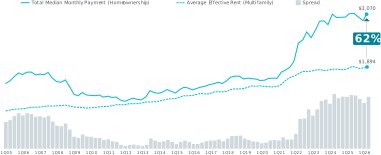
Sources: Newmark Research, RealPage, Atlanta Federal Reserve (July 21, 2026)

Homeowners locked into 4.33% mortgages have little reason to sell into a 6.49% market. That standoff keeps inventory tight and renters renting*.

Existing Loans*
vs
Market Rate*

* Newmark, 2Q26 U.S. Capital Markets Conditions & Trends
Apartment Occupancy Remains Strong Nationwide
With U.S. apartment occupancy at 96% nationally, current trends are a tailwind for rent growth. Full buildings support steady income and help to drive property valuations.*


*RealPage Market Analytics, U.S. apartment occupancy by region, as of Q2 2025.

Strong occupancy is what turns a supply shortage into pricing power. When buildings stay full, rent growth follows.
Our Markets Are Outgrowing the Nation
The national average rent growth rate is 2.86%*. All of Origin’s target markets are forecasted to beat it.
Charlotte
4.31%
Las Vegas
4.14%
Jacksonville
4.06%
Raleigh
4.16%
Dallas
4.22%
San Antonio
3.75%
Atlanta
3.97%
Nashville
4.34%
Orlando
4.41%
Phoenix
3.72%
Miami
5.09%
Denver
4.00%
Austin
3.45%
Tampa
4.52%
Salt Lake City
4.21%

As of 7/01/2026. Represents a five-year prediction for the period 2024-2028. There can be no guarantee that these forecasts will be realized, and actual results may differ.
*Federal Reserve Bank of St. Louis (FRED)