

Quick take: Using leverage correctly in a 1031 exchange is essential to defer taxes and may enhance returns. Investors must match or exceed their original debt to avoid mortgage boot, or taxable shortfalls from insufficient leverage. Three scenarios below illustrate how different debt levels shape flexibility, risk, and tax outcomes, particularly for investors exchanging into Delaware Statutory Trusts, which typically carry embedded non-recourse debt.
Using leverage correctly in a 1031 exchange can help investors defer taxes on appreciated real estate and may enhance returns. But when investors misunderstand it or don’t apply it correctly, it can lead to unexpected tax bills or failed exchanges. This article breaks down the concept of leverage in a 1031 exchange, explains why it matters, and provides examples to illustrate how different levels of debt can affect outcomes.
Leverage Is Critical to a Successful 1031 Exchange
Real estate investors who sell their investment property through a 1031 exchange can defer paying capital gains taxes by reinvesting the proceeds into a “like-kind” replacement property. For an investor to fully defer taxes, they must do three things:
First, use a qualified intermediary (QI) to take possession of the sale proceeds. If an investor takes receipt of sale proceeds directly, they will forfeit their ability to complete a 1031 exchange and pay taxes accordingly.
Second, reinvest all sale proceeds into the replacement property. A partial exchange will likely result in a taxable event.
Third, account for the value of the outstanding mortgage debt (i.e., leverage) on the relinquished property. They can do that by replacing any outstanding mortgage debt with an equal or greater amount of new debt, or with cash. If the investor doesn’t replace enough debt, or doesn’t contribute enough cash to make up the difference, the leftover debt is known as mortgage “boot.” This will trigger capital gains taxes.
Loan to Value: The Math Matters
Loan to value, or LTV, is the ratio of mortgage debt to property value. To calculate LTV, divide the loan amount by the total sale price of the property. For example, a $1,000,000 property with $300,000 in debt has a 30% LTV, while a $1,000,000 property with $700,000 in debt has a 70% LTV.
The lower the LTV on a property, the more flexibility investors have when selecting replacement properties. Lower debt on the relinquished property can also increase an investor’s basis when exchanging into a higher-leveraged 1031 vehicle, since basis is used to calculate depreciation and capital gains. When investors exchange into a Delaware Statutory Trust (DST), a legal structure that lets multiple investors own fractional interests in one or more institutional-quality properties, the debt portion of the investment is typically non-recourse. This means that the investor bears no personal liability for the loan, which is secured solely by the DST’s underlying property. This differs from direct property ownership, where investors may have to personally guarantee new debt. With DSTs, debt is already in place.
Important: DST investments carry other material risks including illiquidity, lack of control over asset management decisions, and potential loss of principal.
Mortgage Boot and Why It Matters
Mortgage boot is triggered when the replacement property has less debt than the relinquished property, and the investor does not contribute enough cash to cover the difference. For example, an investor sells a property with $500,000 of mortgage debt but the replacement property only carries $300,000 of debt. If the investor doesn’t contribute $200,000 in cash to bridge the gap, that shortfall becomes “boot.” The IRS considers the boot a form of financial gain, and the investor is taxed accordingly.
To avoid this, investors must match or exceed both the value and the debt of their original property. You can calculate potential mortgage boot by subtracting the replacement property debt from the relinquished property debt, net of any cash contributed to make up the difference.
How Leverage Impacts a 1031 Exchange
Below are examples of how leverage works for three investors, each entering a 1031 exchange with different levels of debt.
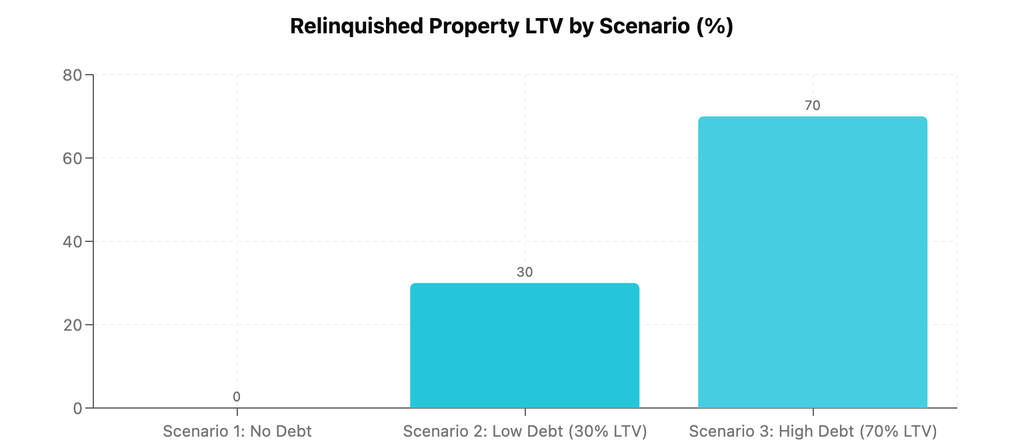
Scenario 1: No Debt1
An investor sells a property for $425,000 with no debt. The DST into which they exchange has a 50% loan-to-value structure.2 Because there’s no existing debt to replace, the investor’s full $425,000 in sale proceeds is treated as equity in the DST, matched by an equal, non-recourse debt allocation of $425,000 under the DST’s 50% LTV structure.
That debt allocation can be used to increase the investor’s tax basis, supporting depreciation deductions and reducing taxable gain on a future sale. With total value and debt fully replaced, the investor completes a tax-deferred 1031 exchange without mortgage boot.
Outcome: Full tax deferral. Basis gained from DST debt allocation.
| Description | Amount |
|---|---|
| Property sale price | $425,000 |
| Original mortgage debt | $0 |
| DST LTV | 50% |
| Investor equity contributed | $425,000 |
| Replacement debt (DST) | $425,000 |
| Total DST position | $850,000 |
| Additional basis from debt | $425,000 |
| Tax outcome | Full deferral, basis gained from DST debt |
Scenario 2: Low Debt1
An investor sells a property for $1,000,000 with $300,000 in existing debt (30% LTV), leaving $700,000 of equity to reinvest. The DST into which they exchange is structured at 50% LTV, so that $700,000 of equity is matched by an equal debt allocation of $700,000, for a total DST position of $1,400,000.
Because the new debt allocation exceeds the original $300,000 loan, and the total position exceeds the $1,000,000 sale price, the investor fully replaces both value and debt using only their sale proceeds; no additional cash is required. The $400,000 increase in debt over the original loan can add to basis, and the exchange completes with no mortgage boot.
Outcome: Full tax deferral. $400,000 increase in debt-based basis; no additional cash required.
| Description | Amount |
|---|---|
| Property sale price | $1,000,000 |
| Original mortgage debt | $300,000 (30%) |
| DST LTV | 50% |
| Investor equity contributed | $700,000 |
| Replacement debt (DST) | $700,000 |
| Total DST position | $1,400,000 |
| Additional basis from debt | $400,000 |
| Tax outcome | Full deferral, basis gained from DST debt |
Scenario 3: High Debt1
An investor sells a property for $1,000,000 with $700,000 in debt (70% LTV), leaving $300,000 of equity. The DST has a 50% LTV structure, so reaching the minimum $1,000,000 replacement value requires $500,000 of equity paired with $500,000 of debt. The investor’s $300,000 equity alone falls short, and the new $500,000 debt allocation is $200,000 less than the original $700,000 loan.
To fully defer taxes, the investor must contribute the $200,000 equity shortfall in cash; that contribution directly offsets the $200,000 reduction in debt, resulting in zero net boot. Absent that contribution, the $200,000 debt reduction is taxed as boot.
Outcome: $200,000 debt shortfall, fully offset by a $200,000 cash contribution to avoid boot. Without that contribution, the $200,000 is taxable.
| Description | Amount |
|---|---|
| Property sale price | $1,000,000 |
| Original mortgage debt | $700,000 (70%) |
| DST LTV | 50% |
| Investor equity contributed (rollover $300,000 + cash $200,000) | $500,000 |
| Replacement debt (DST) | $500,000 |
| Total DST position | $1,000,000 |
| Shortfall (potential mortgage boot before cash contribution) | $200,000 |
| Investor options | Contribute $200,000 or pay tax on boot |
When entering a 1031 exchange, investors must align their existing leverage with the structure of the replacement property or face potentially costly tax consequences. Investors with no or low debt generally experience smoother, more flexible exchanges with better tax outcomes. Investors with high debt must plan carefully or be prepared to contribute more capital to avoid an unexpected tax bill.
About Origin Exchange
We created Origin Exchange to simplify the 1031 exchange process for accredited investors. Origin Exchange offers direct access to institutional-quality multifamily DSTs, competitive fees, and strategically structured leverage. We help investors seek to protect and grow their wealth through tax-efficient real estate investing. To learn more or explore investment opportunities, contact investorrelations@origininvestments.com.
Footnotes:
- These scenarios are hypothetical and for illustrative purposes only; they do not represent actual investor results.
- DST leverage structure based on Origin Exchange program offerings as of Q2 2025. Actual leverage varies by specific DST offering.
Sources:
Internal: Origin Exchange program materials and DST offering structure (current as of Q2 2025)
IRS Publication 544: Sales and Other Dispositions of Assets (like-kind exchange rules)
IRS Revenue Ruling 72-456: Mortgage boot treatment